
Selecting FFKM AS568 O-rings for semiconductor tools
Semiconductor process chambers are hard on elastomers: fluorine and oxygen plasmas, aggressive chemistries and temperatures above 200 °C. Choosing the wrong compound shows up as particles, erosion, compression set and unplanned chamber downtime.
This tutorial explains when perfluoroelastomer (FFKM) is worth its cost over FKM or EPDM, which properties to compare on a datasheet, and how to specify an AS568 size so the quote is right the first time.
Step 1: Compare FFKM, FKM and EPDM for the process
| Property | FFKM (perfluoroelastomer) | FKM (fluoroelastomer) | EPDM |
|---|---|---|---|
| Upper service temperature | Up to 275–327 °C depending on grade (Kalrez plasma grades listed below) | Up to 204 °C, shorter life above that | Up to 150 °C (204 °C in water or steam) |
| Low temperature (static) | Grade dependent; check the datasheet | About −26 °C | About −57 °C |
| Plasma and etch (fluorine, oxygen) | Best resistance; dedicated plasma grades | Erodes faster in aggressive plasma | Not a plasma-chamber material |
| Chemicals | Broadest chemical resistance of the three families | Good for oils, fuels, many acids; not amines, ammonia, alkalis or superheated steam | Good for hot water, steam, many acids, alkalis and polar solvents; not mineral oils |
| High vacuum | Low-outgassing grades available; ask for compound data | Good | Check the compound data |
| Typical tool locations | Chamber lids, gas inlets, slit valves, wafer-contact areas | Less aggressive static seals, pumps, foreline | Wet benches and DI-water lines |
FKM and EPDM values from the Parker O-Ring Handbook ORD 5700. FFKM temperatures from the DuPont Kalrez plasma selector guide.
Step 2: Pick an FFKM grade by process
FFKM is not one material. Manufacturers formulate grades for specific plasma, deposition and thermal steps, and the grade matters more than the family. DuPont lists, for example, Kalrez 9100 (70 Shore A, 300 °C), 9300 (77A, 300 °C), 9500 (76A, 310 °C), 9600 (70A, 315 °C), 8002 (69A, 275 °C) and 8705 (77A, 327 °C) for plasma and deposition applications. Use the manufacturer selector to shortlist, then validate in your chamber.
- Plasma etch and ash: favour low-erosion, low-particle plasma grades.
- CVD and ALD: favour grades with high temperature rating and low compression set at your process temperature.
- Wet process: chemical resistance and low extractables matter more than plasma resistance.
Step 3: Check temperature, outgassing and hardness
- Temperature: compare the continuous rating with the actual seal temperature, not the chamber set point. Compression set grows fast near the limit.
- Outgassing: ask for total mass loss (TML) and collected volatile condensable material (CVCM) measured to ASTM E595, or the manufacturer outgassing data for the exact compound. Do not compare figures measured by different methods.
- Hardness: Shore A per ASTM D2240. Softer grades (about 70A) seal at lower force on smooth flanges; harder grades (about 75–80A) resist extrusion in larger gaps and in dynamic or slit-valve service.
- Purity: for wafer-near seals, ask for metal-ion and particle data and for cleanroom packaging.
Step 4: Specify the AS568 dash size
An AS568 dash number fixes the inside diameter and the cross section. The first digit of the dash number gives the cross-section series, so -014, -114 and -214 are different rings. Measure the groove, or read the dash number from the tool drawing, before you order.
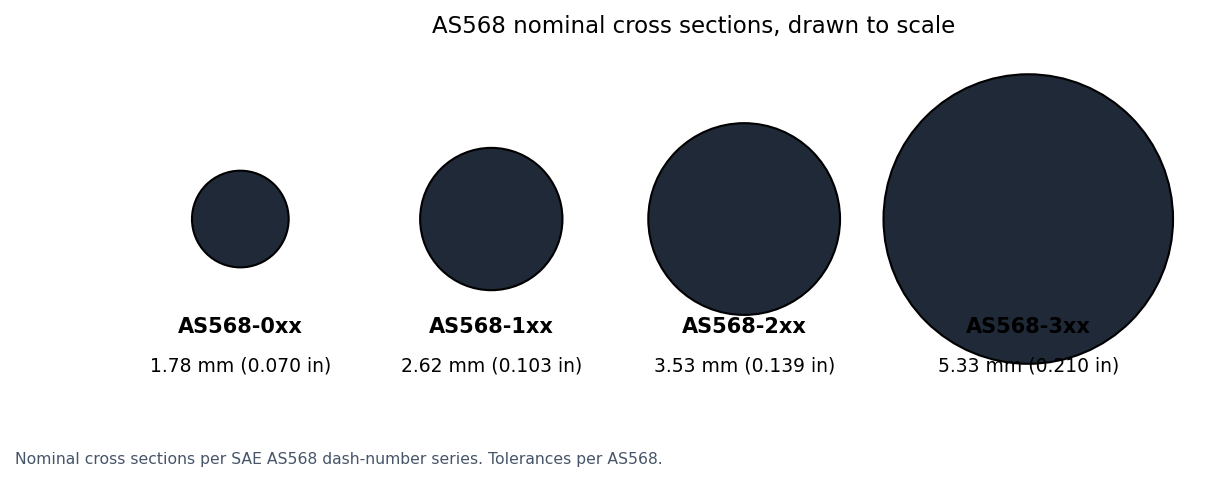
| Series (cross section) | Dash sizes and nominal ID |
|---|---|
| -0xx (1.78 mm) | -006 2.90 · -008 4.47 · -010 6.07 · -012 9.25 · -014 12.42 · -016 15.60 · -018 18.77 · -020 21.95 · -022 25.12 · -024 28.30 · -026 31.47 · -028 34.65 · -030 41.00 |
| -1xx (2.62 mm) | -110 9.19 · -112 12.37 · -114 15.54 · -116 18.72 · -118 21.89 · -120 25.07 · -124 31.42 · -128 37.77 · -133 45.69 · -138 53.64 |
| -2xx (3.53 mm) | -210 18.64 · -214 24.99 · -218 31.34 · -222 37.69 · -226 50.39 · -230 63.09 · -234 75.79 |
| -3xx (5.33 mm) | -325 37.47 · -330 53.34 · -335 69.22 · -340 85.09 · -345 100.97 · -350 116.84 |
Nominal dimensions per SAE AS568. FFKM compound and hardness are confirmed in the quote; the same sizes are also listed in FKM 75.
RFQ checklist
- AS568 dash number, or groove dimensions and the seal type (static face, static radial, dynamic).
- Tool, chamber and seal location, process gases and chemistries.
- Maximum seal temperature and thermal cycling.
- Current compound and the failure you see: erosion, particles, compression set, cracking.
- Outgassing, purity and cleanroom-packaging requirements.
- Quantity and whether you need a qualification sample first.
Frequently asked questions
When is FFKM worth the cost over FKM?
When the seal sees aggressive plasma, temperatures above the roughly 204 °C FKM limit, or chemicals FKM does not tolerate such as amines and ammonia. For mild static seals FKM is often sufficient.
Can EPDM be used in a plasma chamber?
EPDM is not a plasma-chamber material. It is a good choice for hot water, steam and many acids and alkalis, such as wet benches and DI-water lines, but it is not compatible with mineral oils.
Which outgassing figure should I ask for?
Ask for TML and CVCM measured to ASTM E595, or the manufacturer outgassing data for the exact compound, so you compare like with like.
Do -014, -114 and -214 fit the same groove?
No. They have different cross sections (1.78, 2.62 and 3.53 mm) and different inside diameters. The first digit of the dash number gives the cross-section series.
What hardness should I choose?
Around 70 Shore A for low closing force on smooth static flanges; about 75–80 Shore A where extrusion or dynamic service is a concern. Follow the hardness of the grade the tool maker specifies.
Ask an engineer
Send the dash number, process step, seal temperature and the failure you see. MST, as distributor, helps shortlist FFKM grades to validate in your tool and quotes the sizes you need.
Ask an engineerRelated pages
Sources
- Parker O-Ring Handbook ORD 5700
- DuPont Kalrez plasma selector guide (KZE-A40111-00-A0422)
- SAE AS568 aerospace size standard for O-rings
- ASTM E595 outgassing test method
- ASTM D2240 durometer hardness
Values are taken from the manufacturer documents above, checked 2026-10-24. Specifications can change; confirm against the current datasheet before ordering. MST is a distributor; products are made by the manufacturers named.