
Short answer: An AS568 dash number fixes the inside diameter and the cross section, and the first digit gives the cross-section series. Material and hardness are specified separately. Size the ring from the groove, check the squeeze, then choose FKM or FFKM for the process. This post summarises our [AS568 O-ring size and material guide](/buying-guides/as568-o-ring-size-material-guide), which includes an interactive gland calculator.
Dimensions come from the Parker O-Ring Handbook ORD 5700. MST distributes O-rings and is not the manufacturer.
Step 1: Read the dash-number series
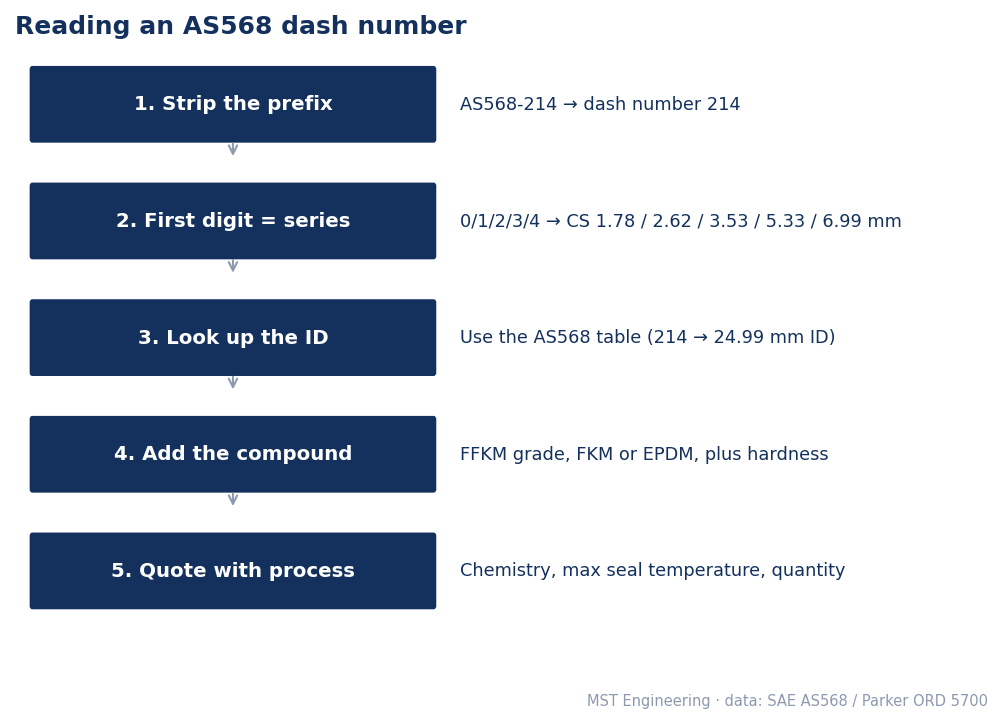
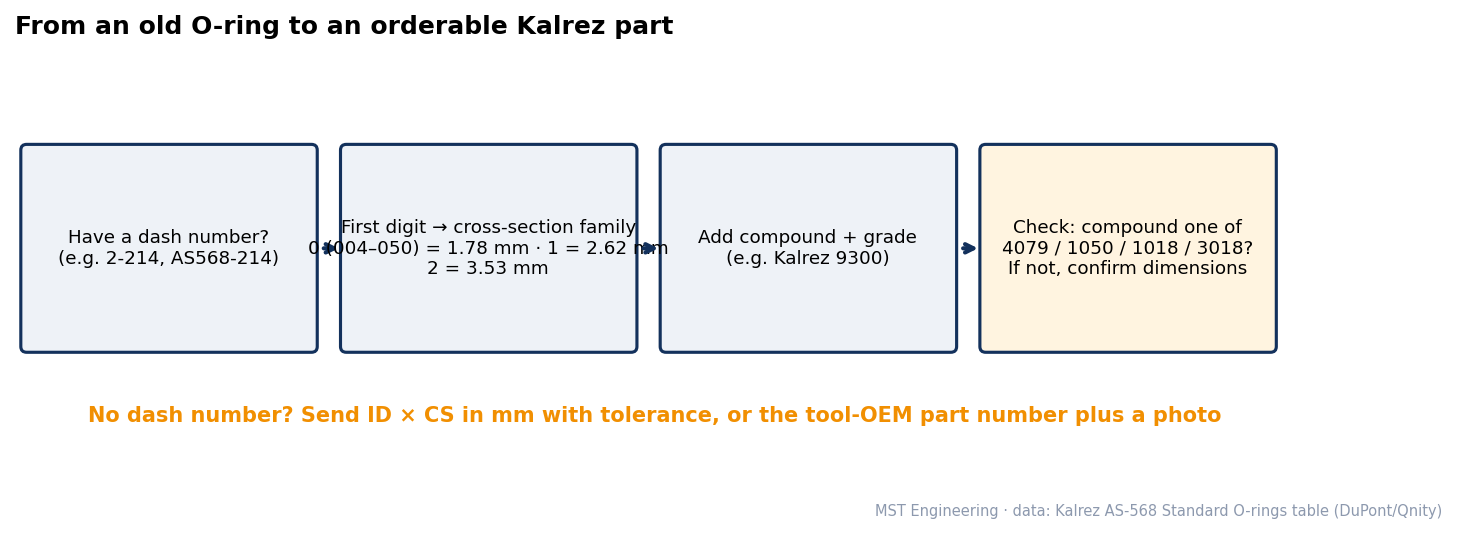
Flowchart by MST Engineering.
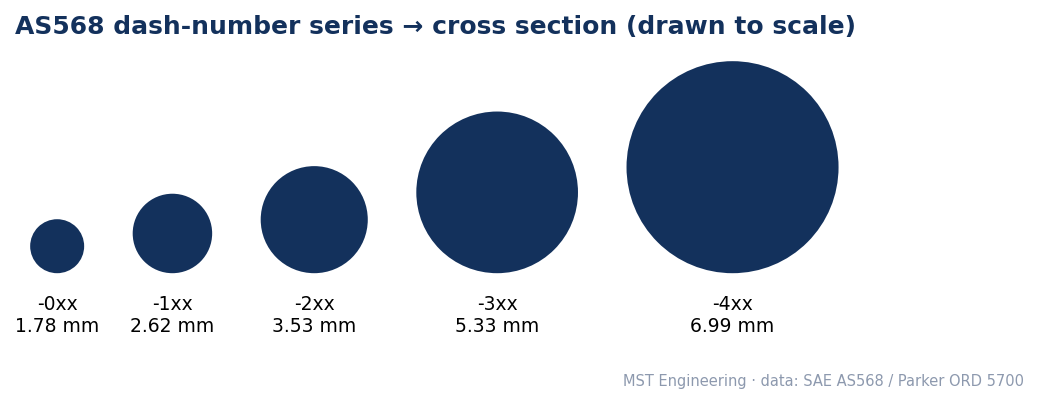
Drawn to scale by MST Engineering from SAE AS568 and Parker ORD 5700.
| Dash series | Nominal CS | Actual CS | Tolerance |
|---|---|---|---|
| -004 to -050 | 1/16 in | 0.070 in (1.78 mm) | ±0.003 in |
| -102 to -178 | 3/32 in | 0.103 in (2.62 mm) | ±0.003 in |
| -201 to -284 | 1/8 in | 0.139 in (3.53 mm) | ±0.004 in |
| -309 to -395 | 3/16 in | 0.210 in (5.33 mm) | ±0.005 in |
| -425 to -475 | 1/4 in | 0.275 in (6.99 mm) | ±0.006 in |
A legacy number such as Parker 2-214 ends in the AS568 dash number: AS568-214.
Step 2: Size the ring from the groove
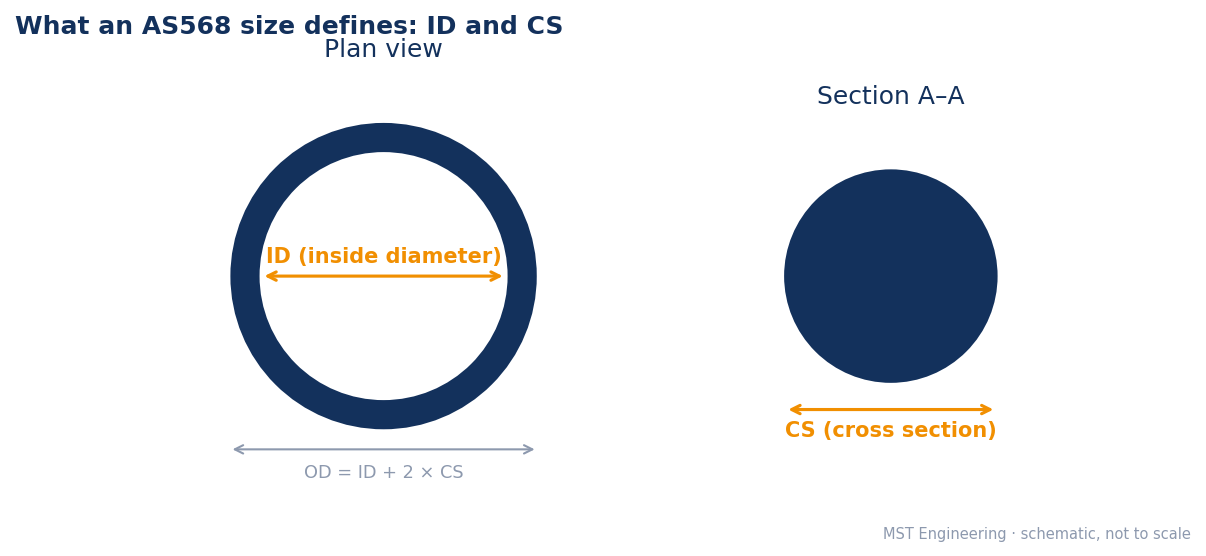
Schematic by MST Engineering, not to scale.
1. The gland depth and groove width set the cross section. The groove diameter sets the inside diameter.
2. Do not change the cross section without changing the groove.
3. Calculate the squeeze: (CS − gland depth) ÷ CS. For example, a -2xx ring (0.139 in) in a 0.104 in deep gland gives (0.139 − 0.104) ÷ 0.139 = 25.2 %.
4. Calculate the stretch: (groove diameter − ring ID) ÷ ring ID. Also check gland fill, then compare all three results with the Parker design chart for your seal type.
Parker notes that perfluoroelastomers may need more squeeze than FKM, and that groove recommendations may need adjusting for semiconductor applications.
Step 3: Choose FKM or FFKM
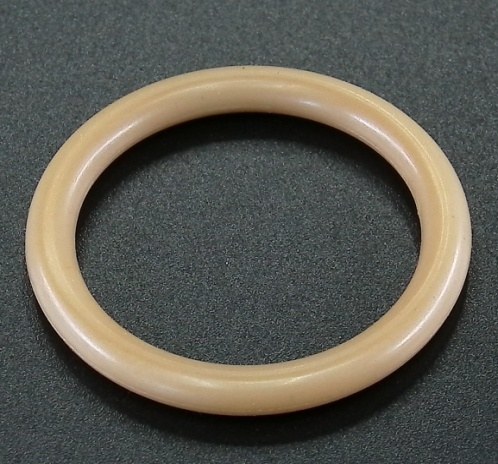
Representative product photo (MORISEAL 5130UP).
- FKM covers many general seals. Its temperature limit depends on the compound, so read the FKM compound data sheet.
- FFKM is worth its cost for seal temperatures above the FKM limit, for plasma, ozone or aggressive wet chemistry, for low outgassing or particle requirements, and where downtime costs more than the seal.
- The DuPont plasma selector lists Kalrez maximum service temperatures from 275 °C (8002) to 327 °C (8705). See the [FFKM grade-by-process summary](/community/c/o-rings-seals).
RFQ checklist
Flowchart by MST Engineering.
1. Dash number (or ID and CS) and quantity.
2. Material: FKM with hardness, or FFKM with the compound or the process conditions.
3. Temperature, chemistry or plasma gases, vacuum or pressure, static or dynamic.
4. The OEM part number if you are replacing a tool seal.
Original OEM documents (links only)
1. Parker Hannifin, Parker O-Ring Handbook ORD 5700. https://www.parker.com/content/dam/Parker-com/Literature/O-Ring-Division-Literature/ORD-5700.pdf
2. DuPont, Kalrez AS-568 standard O-rings and metric equivalents. https://www.qnityelectronics.com/content/dam/electronics/amer/us/en/kalrez/public/documents/en/Kalrez_AS-568_Standard_O-rings.PDF
Ask an engineer
Send the dash numbers and process conditions through [Ask an engineer](/rfq?entry_source=ask_engineer&search_term=AS568+O-ring&quantity=1&community_path=%2Fbuying-guides%2Fas568-o-ring-size-material-guide). MST confirms the compound with the manufacturer and replies with price and lead time. Browse [AS568 O-rings](/store/as568-o-rings). Or post a [find-part request](/community/new?kind=part_request&mpn=AS568-214). For parts outside this list, use a [sourcing RFQ](/services/sourcing-rfq?sourcing_mode=supplier_match).
Catalog parts in this guide