
Short answer: Pick a QFN socket by matching four things on your device drawing: lead count, body size, lead pitch and the exposed (thermal) pad. Then choose the lid style and confirm the use case. The same lead count can come in more than one body: QFN48, for example, exists as 6 × 6 mm at 0.4 mm pitch and 7 × 7 mm at 0.5 mm pitch, and the two need different sockets. A socket holds a packaged IC; for bare die, package the die first.
The sockets below are Plastronics QN-series sockets made by Smiths Interconnect. MST distributes them and is not the manufacturer. Series data comes from the Smiths Interconnect QN-series page. Socket models are the ones listed on MST Store.
Step 1: Read four values from the device drawing
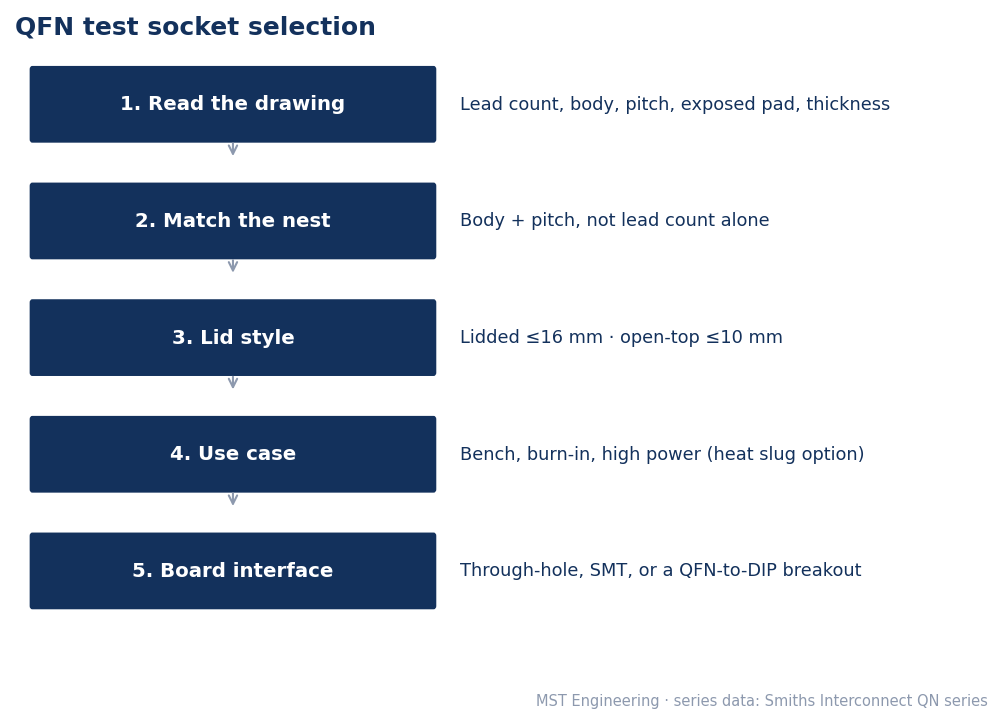
Flowchart by MST Engineering.
| Value | Where to find it | Why it matters |
|---|---|---|
| Lead count | Package name (QFN32 and so on) | Sets the contact count |
| Body size | Package outline drawing (mm) | The socket nest is sized to the body |
| Lead pitch | Outline drawing | The contacts are on a fixed pitch |
| Exposed pad and thickness | Outline drawing / JEDEC MO-220 variant | QN sockets have a centre ground pin as standard; the package thickness must suit the nest |
Step 2: Match a socket
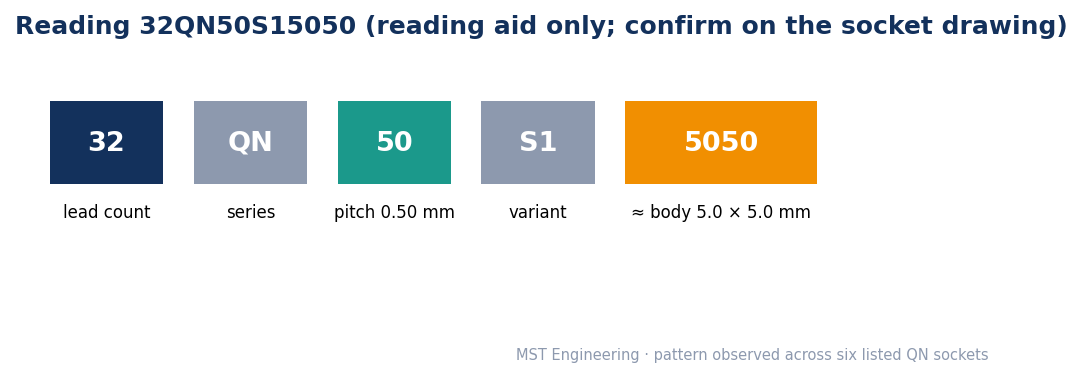
Reading aid by MST Engineering. Confirm on the socket drawing.
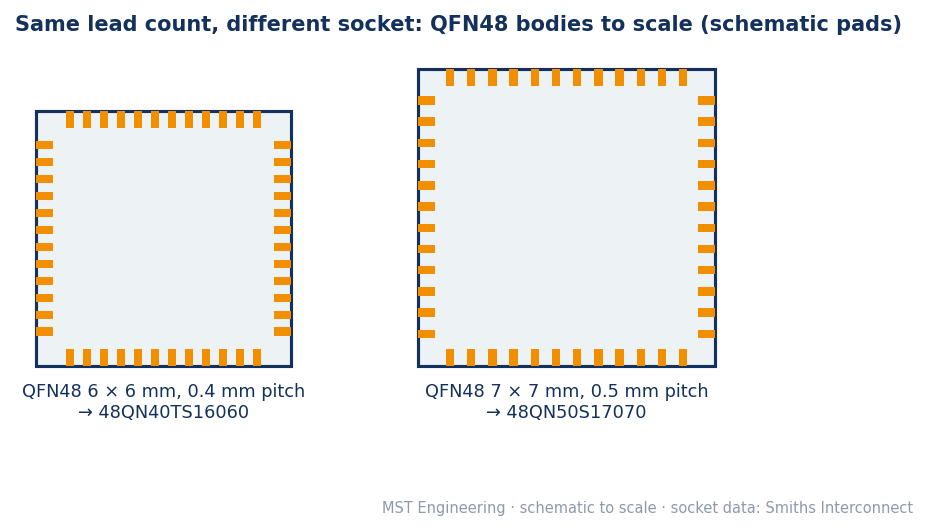
Schematic by MST Engineering, drawn to scale with simplified pads.
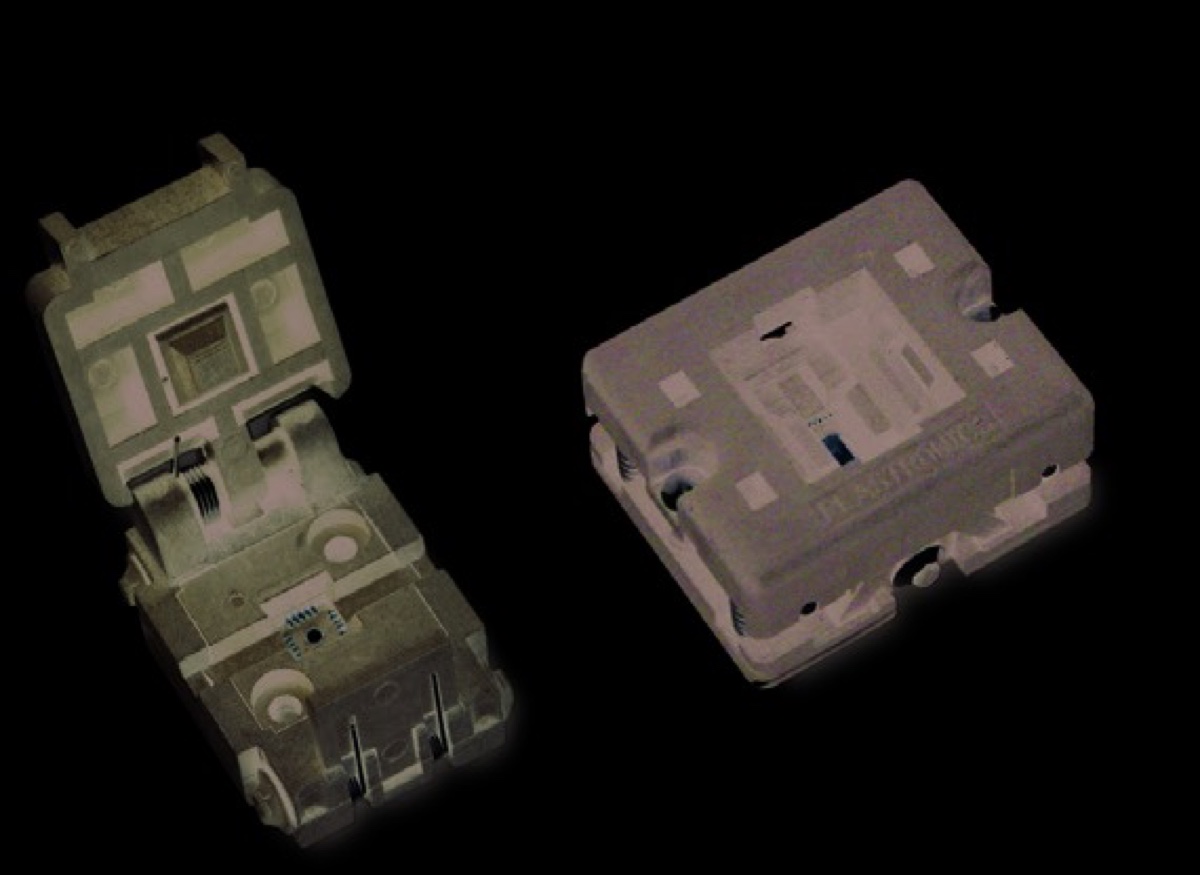
Product photo of the listed socket (Plastronics / Smiths Interconnect).
| Package | Body | Pitch | Socket (Plastronics / Smiths Interconnect) | Style |
|---|---|---|---|---|
| QFN16 | 3 × 3 mm | 0.5 mm | [16QN50S23030](/store/ic-test-sockets/SKT-QFN16-3X3) | Lidded clamshell, spring probe |
| QFN24 | 4 × 4 mm | 0.5 mm | [24QN50S14040](/store/ic-test-sockets/SKT-QFN24-4X4) | Lidded clamshell, spring probe |
| QFN32 | 5 × 5 mm | 0.5 mm | [32QN50S15050](/store/ic-test-sockets/SKT-QFN32-5X5) | Lidded clamshell, spring probe |
| QFN48 | 6 × 6 mm | 0.4 mm | [48QN40TS16060](/store/ic-test-sockets/SKT-QFN48-6X6) | Lidded clamshell, spring probe |
| QFN48 | 7 × 7 mm | 0.5 mm | [48QN50S17070](/store/ic-test-sockets/SKT-QFN48-7X7) | Lidded clamshell, spring probe |
| QFN64 | 9 × 9 mm | 0.5 mm | [64QN50S19090](/store/ic-test-sockets/SKT-QFN64-9X9) | Lidded clamshell, spring probe |
In these six part numbers, the first digits are the lead count, "QN" is the series, the next two digits are the pitch (50 = 0.50 mm, 40 = 0.40 mm), and the last four digits follow the body size (for example 5050 = 5 × 5 mm). Use this only as a reading aid and confirm on the socket drawing.
Step 3: Choose the lid style
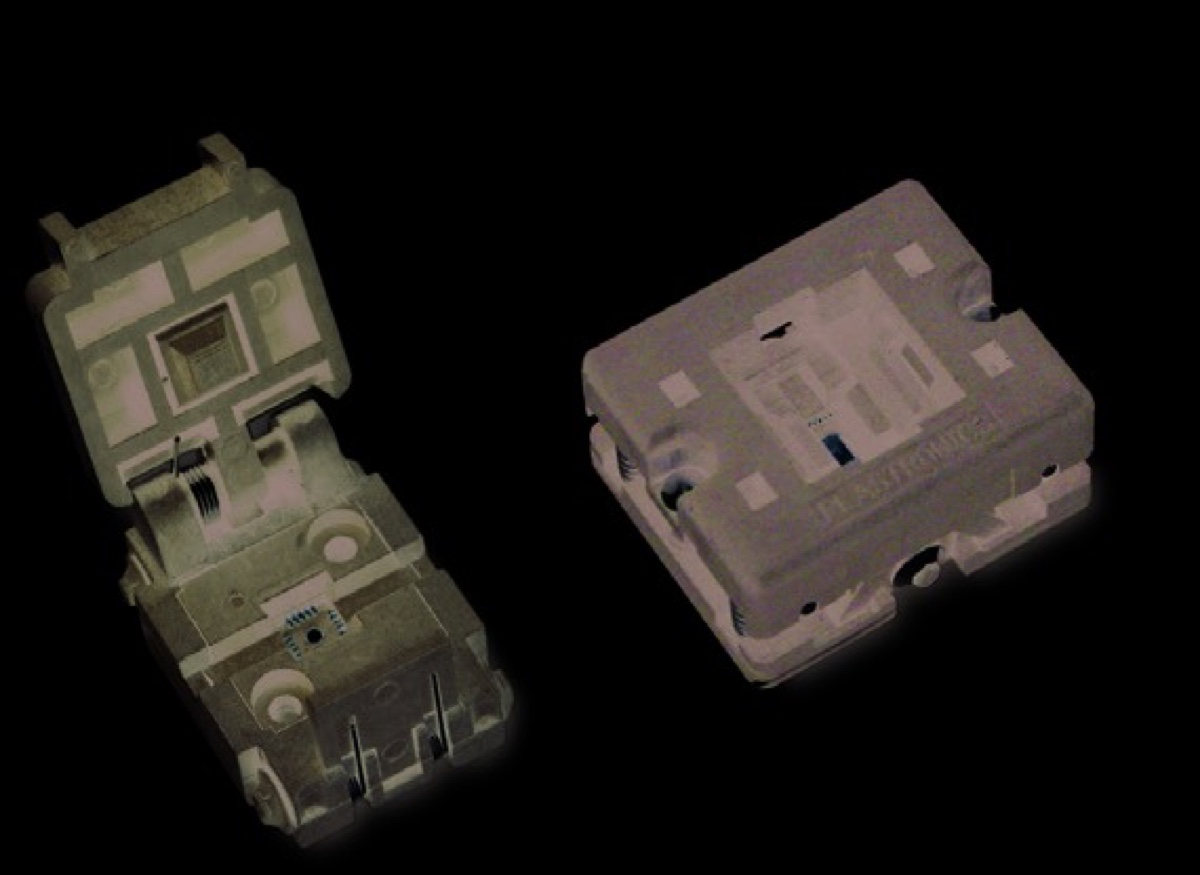
Product photo of the listed socket (Plastronics / Smiths Interconnect).
| Style | Smiths Interconnect QN-series availability | Good for |
|---|---|---|
| Lidded (clamshell) | Packages up to 16 mm (≤10 mm and 10–16 mm) | Bench validation and burn-in |
| Open-top | Packages up to 10 mm, in most of the same lead counts | Frequent manual swaps and handler loading |
The series covers 0.40, 0.50, 0.65, 0.80 and 1.00 mm pitches, with custom pitches down to 0.35 mm. Smiths Interconnect lists sockets for over 80 JEDEC standard footprints. An optional copper heat slug is available for high-wattage devices.
Step 4: Confirm the use case and board interface
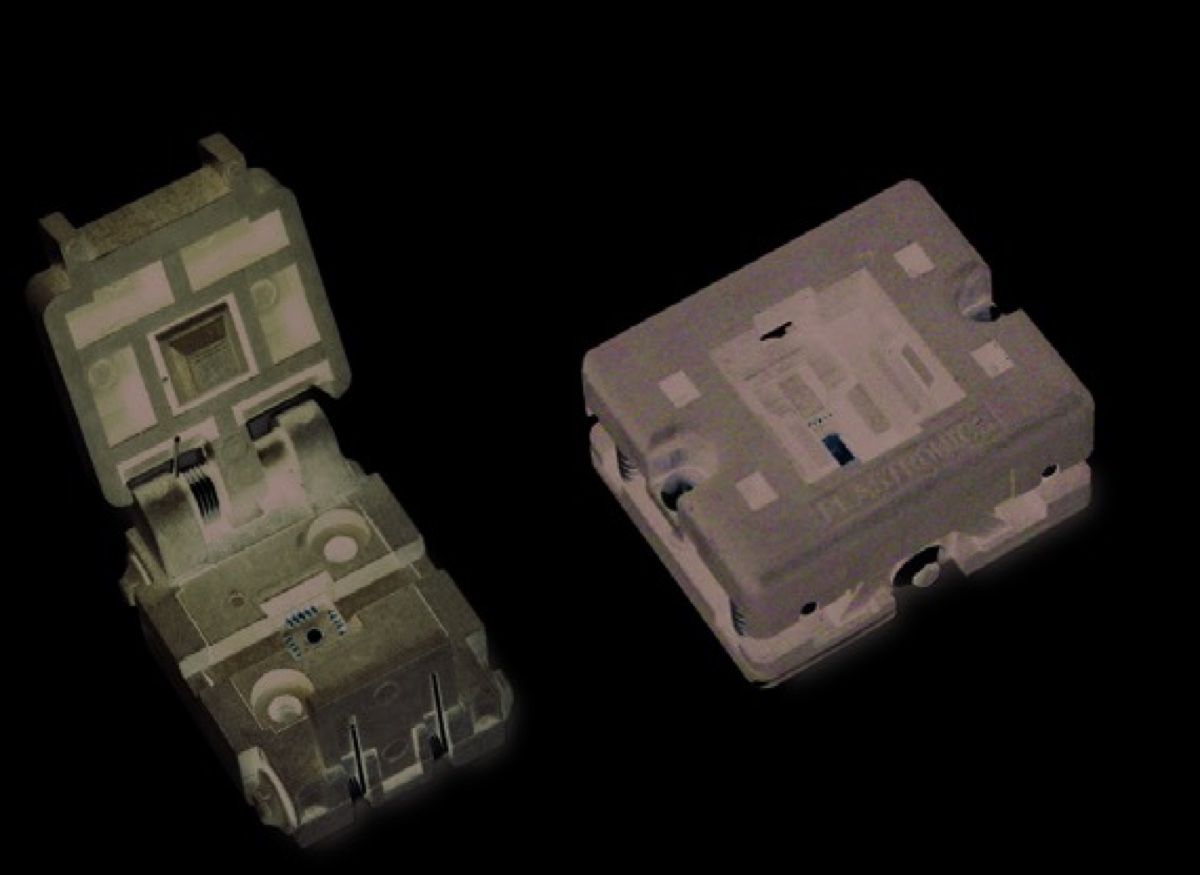
Product photo of the listed socket (Plastronics / Smiths Interconnect).
1. Bench validation or burn-in: confirm the temperature range and cycle life for your run with the manufacturer.
2. High power: ask about the copper heat-slug option.
3. No test board yet: a QFN-to-DIP breakout board is a separate item. Breadboard-style adapters such as Proto-Advantage PA0067 (QFN32), PA0073 (QFN48) and IPC0032 (QFN64) are listed under [breakout and evaluation boards](/store/breakout-evaluation-boards).
4. Prototype die: put the die in an open-cavity QFN package first. The ALNP packages follow JEDEC MO-220, so a socket for the same body, lead count and pitch should fit. See the [open-cavity package summary](/community/c/ic-packages-lids).
Not a QFN?
For QFP64 (10 × 10 mm, 0.5 mm), MST lists the Enplas OTQ-64-0.5-01, an open-top socket with pinch contacts. For SOIC8 (150 mil) programming, MST lists the Elnec DIL8W/SOIC8 ZIF adapter 70-0901. Our [IC test socket selection guide](/buying-guides/ic-test-socket-selection-guide) covers both.
RFQ checklist
1. Package outline drawing or JEDEC variant, lead count, body size, pitch and exposed-pad size.
2. Use case (bench, programming, final test, burn-in) and temperature range.
3. Board interface: through-hole, surface-mount, or an existing footprint you must match.
4. Quantity and target date.
Original OEM documents (links only)
1. Smiths Interconnect, Plastronics QN series QFN sockets. https://www.smithsinterconnect.com/products/semiconductor-test/semiconductor-burn-in/bga-lga-qfn-sockets/qn-series/
2. Marvin Test Solutions KB Q200240, IC test socket contamination. https://www.marvintest.com/KB/Q200240/IC-Test-Socket-Contamination
Ask an engineer
Send the package drawing and use case through [Ask an engineer](/rfq?entry_source=ask_engineer&search_term=QFN+test+socket&quantity=1&community_path=%2Fcommunity%2Fc%2Ftest-sockets). MST checks the matching socket with Smiths Interconnect and replies with price and lead time. Browse all [IC test sockets](/store/ic-test-sockets). Or post a [find-part request](/community/new?kind=part_request&mpn=32QN50S15050). For parts outside this list, use a [sourcing RFQ](/services/sourcing-rfq?sourcing_mode=supplier_match).
Parts
Catalog parts in this guide
- Plastronics 16QN50S23030 QFN16 3 × 3 mm 0.5 mm clamshell burn-in / test socket
- Plastronics 24QN50S14040 QFN24 4 × 4 mm 0.5 mm clamshell burn-in / test socket
- Plastronics 32QN50S15050 QFN32 5 × 5 mm 0.5 mm clamshell burn-in / test socket
- Plastronics 48QN40TS16060 QFN48 6 × 6 mm 0.4 mm clamshell burn-in / test socket
- Plastronics 48QN50S17070 QFN48 7 × 7 mm 0.5 mm clamshell burn-in / test socket