
**Short answer:** An OEM number such as AMAT 0200-10073 identifies a *part*, not a material grade. Public reseller listings put quartz, sapphire, ceramic, AlN and even graphite items under the same 0200- prefix, so the prefix alone doesn't tell you the material. The material is defined on the OEM drawing. When a supplier offers "high-purity quartz", ask for the **grade and the datasheet revision**. Heraeus HSQ® 300 and 330 differ only in Na, K and Cu in the current sheet. Synthetic grades trade OH content and high-temperature limits against purity. Different makers' tables use different units and column orders.
What the part number tells you, and what it doesn't
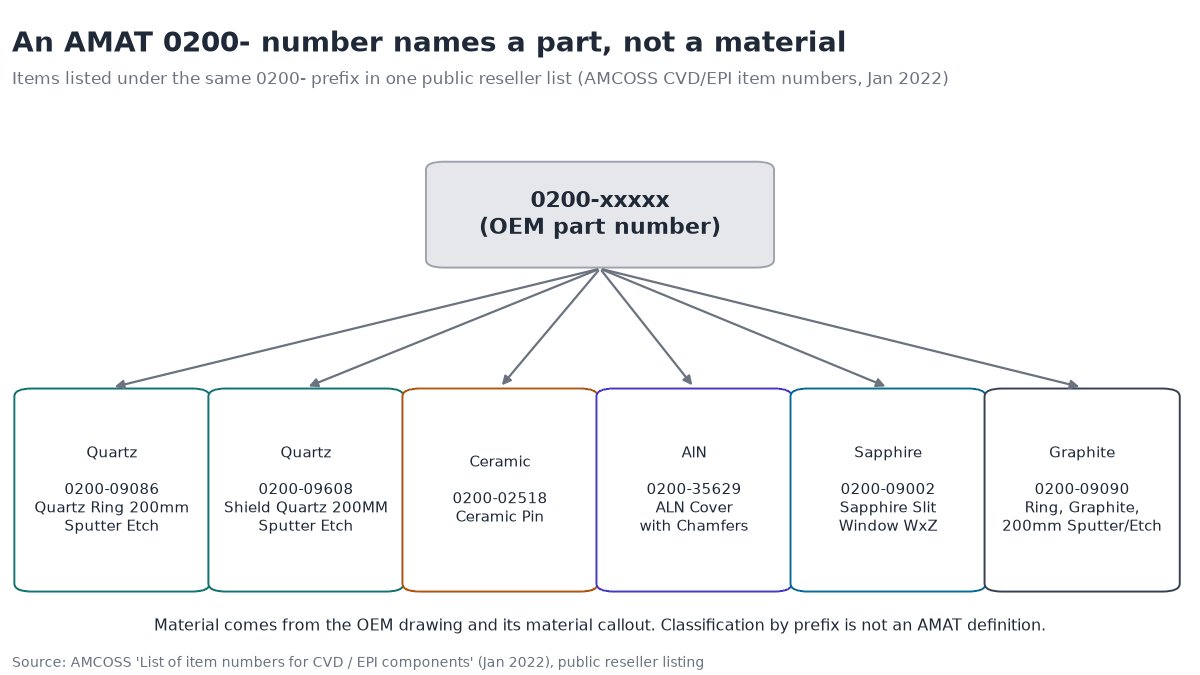
AMAT does not publish a public decoder for its part-number prefixes. What we can see is how public listings use them:
- Asseta lists **AMAT 0200-10073** as "INSULATOR,QUARTZ,200MM, SIMPLE CATHODE", with market activity "Requested multiple times · most recently December 2023".
- AMCOSS's public "List of item numbers for CVD / EPI components" (Jan 2022) maps its own item numbers to OEM numbers. Under the 0200- prefix it lists, among others: "Quartz Ring 200mm Sputter Etch" (0200-09086, P5000), "Ring QTZ THK 150mm Sputter Etch" (0200-09087), "Shield Quartz 200MM Sputter Etch" (0200-09608), "Ceramic Pin" (0200-02518, Producer), "ALN Cover with Chamfers" (0200-35629, DxZ), "Sapphire Slit Window WxZ" (0200-09002) and "Ring, Graphite, 200mm Sputter/Etch" (0200-09090).
Two takeaways:
1. **0200- is not "quartz".** In this one list it covers quartz, ceramic, AlN, sapphire and graphite parts. Classify by the description and the drawing, not the prefix. Evidence level: *observed in public reseller listings*, not an AMAT definition.
2. **Descriptions can contradict themselves.** The same AMCOSS list shows 0200-09005 as "Window Sapphire" with "(Quartz)" printed under the number. Some entries carry a "~" before the OEM number (e.g. "~0200-02518" for "Ceramic Pin w/o tip"), and the list doesn't explain it. Resolve both kinds of ambiguity with the drawing or a photo of the old part before quoting.
Interchangeability between an OEM 0200- part and any non-OEM ("compatible") quartz part is **not established** by any of these listings.
Material grades: two makers' tables, side by side
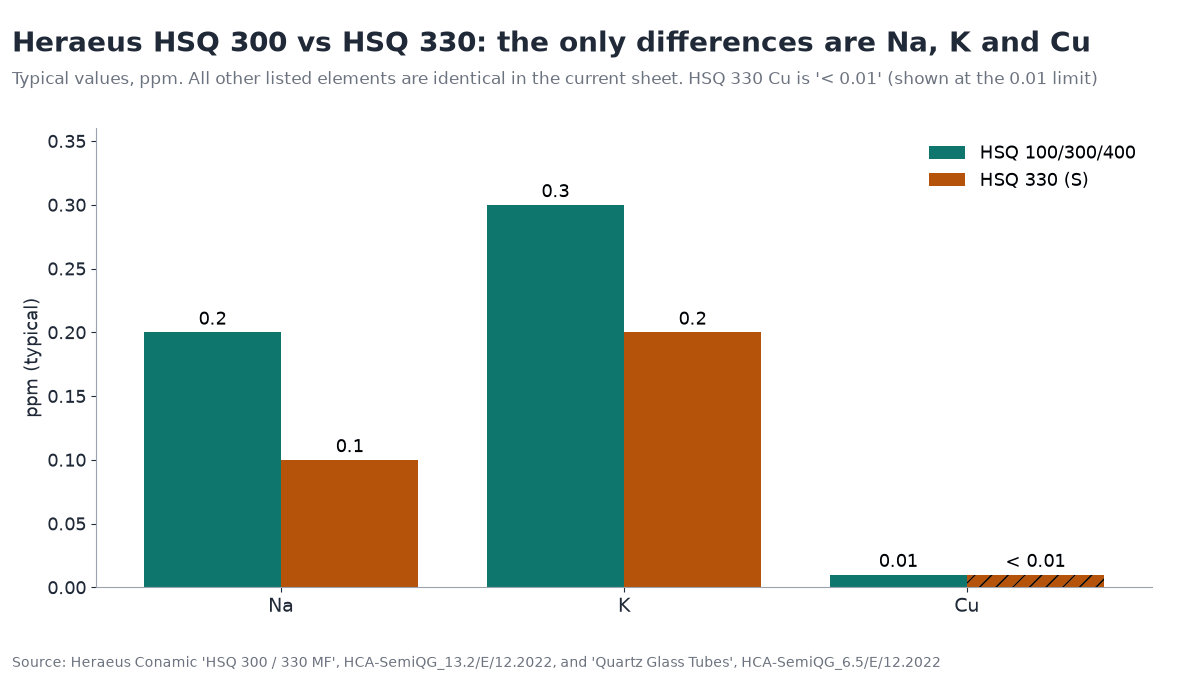
**Heraeus (Conamic) – current sheets.** "Quartz Glass Tubes" (HCA-SemiQG_6.5/E/12.2022) and "HSQ® 300 / 330 MF" (HCA-SemiQG_13.2/E/12.2022). Both say data is correct as of June 2022. Typical values, ppm:
| Grade | Type | Li | Na | K | Ca | Fe | Cu | Ti | Zr | Al | OH |
|---|---|---|---|---|---|---|---|---|---|---|---|
| HSQ® 100/300/400 | electrically fused | 0.5 | 0.2 | 0.3 | 0.5 | 0.1 | 0.01 | 1.1 | 1.0 | 15 | < 30* |
| HSQ® 330 (S) | electrically fused | 0.5 | 0.1 | 0.2 | 0.5 | 0.1 | < 0.01 | 1.1 | 1.0 | 15 | < 30* |
| HSQ® 700 | electrically fused | < 0.01 | < 0.02 | 0.1 | 0.4 | 0.1 | < 0.01 | 1.1 | 1.0 | 15 | < 30* |
| HSQ® 900 | synthetic | < 0.002 | < 0.01 | < 0.01 | < 0.02 | < 0.03 | < 0.001 | < 0.03 | < 0.04 | < 0.04 | 0.2 |
| HSQ®-T | synthetic | < 0.01 | < 0.01 | < 0.01 | < 0.02 | < 0.01 | < 0.01 | < 0.01 | < 0.01 | < 0.01 | 150–200 |
\*"OH content can be reduced by additional annealing." (Mg, Cr, Ni, Mn columns omitted here for width. See the source.)
**Momentive Technologies – "Quartz Tubes"** (2-page PDF, © 2025). "Typical Momentive quartz grade impurity levels (PPMW)":
| Grade | Positioning (Momentive) | Al | Ca | Cu | Fe | Li | K | Na | Ti | Zr |
|---|---|---|---|---|---|---|---|---|---|---|
| 214 | High purity, natural sand | 15 | 0.5 | < 0.04 | 0.2 | 0.5 | 0.4 | 0.8 | 1.0 | 0.9 |
| 224 | Low alkali | 8 | 0.6 | < 0.003 | 0.2 | 0.2 | 0.1 | 0.1 | 1.4 | 0.6 |
| 244 | Low aluminium / low alkali | 8 | 0.6 | < 0.003 | 0.2 | 0.2 | 0.1 | 0.1 | 1.4 | 0.6 |
| 021 | Ultra-high purity, synthetic sand | 0.02 | < 0.05 | < 0.03 | 0.08 | < 0.05 | < 0.05 | < 0.05 | < 0.02 | < 0.05 |
Pitfalls when comparing these tables
- **Column order differs.** Heraeus starts with Li, Na, K. Momentive starts with Al, Ca, Cu. Copy-paste comparisons often shift a column. Re-key by element name.
- **Units and basis differ.** Momentive says PPMW. An older Heraeus sheet for CFQ 099 / HSQ 100 / 300 / 700 (copy hosted by a German distributor) labels its table "ppm by weight oxide" and gives different HSQ 300 numbers (e.g. Li 0.6, Na 0.3, K 0.4) from the current sheet (Li 0.5, Na 0.2, K 0.3). Quote the **document code and date**, not just the grade.
- **Momentive's table has no OH column; Heraeus's does.** For high-temperature parts OH matters (see below), so ask for it explicitly.
- **Two Momentive rows are identical.** 224 and 244 have the same impurity numbers in this table, while the positioning text says 244 is the "low Al + low alkali" grade. Ask Momentive or the fabricator which spec actually separates them before using this table to choose between them.
- **All values are "typical".** Momentive's sheet says customers "must evaluate" its products and "make their own determination as to fitness of use", and points to Certificates of Analysis. Heraeus labels its tables "Typical Values". For a chamber part, the CoA plus the OEM drawing's material callout is what counts.
Electrically fused vs synthetic: the thermal trade-off
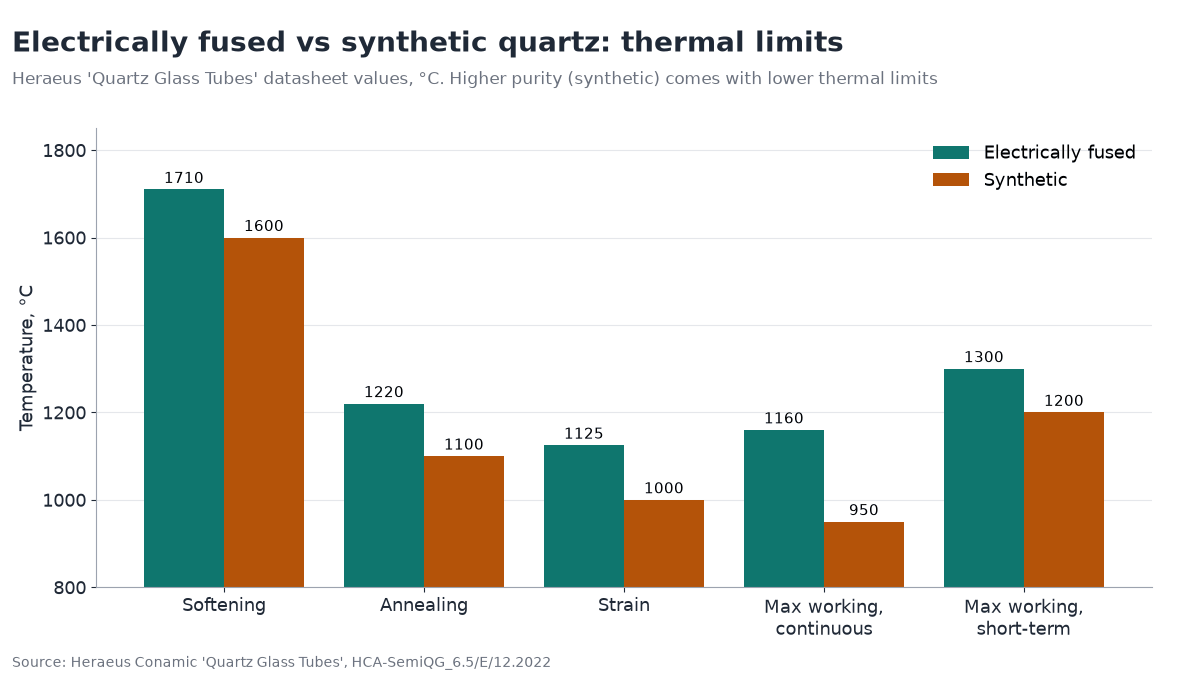
From the Heraeus tubes sheet:
| Property | Electrically fused | Synthetic |
|---|---|---|
| Softening temperature | 1710 °C | 1600 °C |
| Annealing temperature | 1220 °C | 1100 °C |
| Strain temperature | 1125 °C | 1000 °C |
| Max working temperature, continuous | 1160 °C | 950 °C |
| Max working temperature, short-term | 1300 °C | 1200 °C |
Higher purity (synthetic) doesn't automatically mean "better" for a hot part. On this sheet the synthetic family has lower thermal limits, and HSQ-T carries 150–200 ppm OH against < 30 ppm for the electrically fused grades. Heraeus describes HSQ® 300/330 MF's low OH content as making it "suitable for high-temperature applications". For a plasma-etch ring the drivers are different (purity, dimensional tolerance, surface finish). Write down which drivers apply before accepting a substitute grade.
Momentive's 214 sits in a similar Al range (15 ppm) to Heraeus HSQ 300 (15 ppm). That is a **similarity in one column**, not an equivalence. Interchangeability not established.
How to verify fit before ordering
1. Get the OEM **drawing number and revision** (or a dimensioned photo of the old part plus the chamber/kit context).
2. Confirm the material callout: quartz type/grade, or "clear fused quartz" with a purity spec.
3. Ask the fabricator which **raw-material grade and datasheet revision** they will use, and for a CoA per lot.
4. Check critical dimensions and surface finish (fire-polished, mechanically polished, bead-blasted). These come from the drawing, not the material sheet.
5. For "compatible" parts, agree a first-article inspection before series supply.
What to send in an RFQ for a 0200- (or any OEM) quartz part
- OEM part number + description exactly as on the label/BOM (e.g. "0200-10073 INSULATOR, QUARTZ, 200MM").
- Tool platform, chamber, wafer size.
- Drawing and revision if you have it. Otherwise photos with a ruler, plus key dimensions.
- Required material grade or purity spec, and whether OH content is controlled.
- New OEM, new non-OEM (to drawing), or refurbished/cleaned.
- Quantity, CoA / CoC requirements, cleanroom packaging.
FAQ
**Does "0200-" mean the part is quartz?** No. Public listings show quartz, sapphire, ceramic, AlN and graphite parts under 0200-. Use the description and drawing.
**Is HSQ 330 better than HSQ 300?** In Heraeus's current table it has lower Na (0.1 vs 0.2), K (0.2 vs 0.3) and Cu (< 0.01 vs 0.01) ppm. The other listed elements are the same. Whether that matters depends on your contamination spec.
**Is synthetic fused silica always the right upgrade?** Not for high-temperature parts. In Heraeus's data its continuous working limit is 950 °C vs 1160 °C for electrically fused, and HSQ-T's OH is 150–200 ppm.
*Applied Materials/AMAT, Heraeus, HSQ, Momentive and 214 are trademarks of their respective owners. OEM names and part numbers are used for identification only. MST is not affiliated with or endorsed by these companies.*
Original OEM documents (links only)
1. Heraeus Conamic, "Quartz Glass Tubes" datasheet, HCA-SemiQG_6.5/E/12.2022 (data correct as of June 2022). https://www.heraeus-covantics.com/media/Media/Documents/Products_and_Solutions/SEMI/EN/Quartz_Tubes_EN.pdf
2. Heraeus Conamic, "HSQ® 300 / 330 MF" datasheet, HCA-SemiQG_13.2/E/12.2022. https://www.heraeus-covantics.com/media/Media/Documents/Products_and_Solutions/SEMI/EN/Solids_HSQ300_330MF_EN.pdf
3. Momentive Technologies, "Quartz Tubes" product sheet (© 2025). https://www.momentivetech.com/wp-content/uploads/2026/04/momentive-technologies-quartz-tubes.pdf
Other public references used (reseller/distributor listings, not OEM definitions):
- Heraeus Quarzglas, "CFQ 099 / HSQ 100 / HSQ 300 / HSQ 700 Electrically Fused Quartz Glass" (older sheet, distributor-hosted copy). https://www.quarzglas-heinrich.de/wp-content/uploads/HSQ300.pdf
- Asseta, "AMAT 0200-10073" listing (accessed 2026-10-19). https://www.asseta.com/parts/amat-0200-10073
- AMCOSS, "List of item numbers for CVD / EPI components" (PDF, Jan 2022). https://amcoss.com/wp-content/uploads/2022/01/CVD-EPI-Item-Numbers-01_22.pdf
Request a quote
Need a quartz, ceramic or sapphire chamber part identified or quoted? Include the drawing and revision, or photos with a ruler. Post a [find-part request](/community/new?kind=part_request&mpn=0200-10073) with the details above, or send a [sourcing RFQ](/services/sourcing-rfq?sourcing_mode=supplier_match). MST replies in the thread or by email. MST does not claim stock of any item mentioned here; sourcing is done on request.