
Short answer: Before you reorder a failed O-ring, look at it in cross section. A ring with flat sides and no rebound has taken a compression set. Material squeezed into the clearance gap means extrusion. An oversized, soft ring has swelled in an incompatible fluid. A pitted or powdery face points to plasma or chemical attack, and blisters or internal splits point to rapid gas decompression. Each cause has a different fix. Reordering the same compound fixes none of them.
The failure modes below follow the failure-analysis section of the Parker O-Ring Handbook (ORD 5700). Temperatures and grade data come from Parker and the DuPont Kalrez semiconductor selector guides. MST distributes seals from several manufacturers and does not make O-rings.
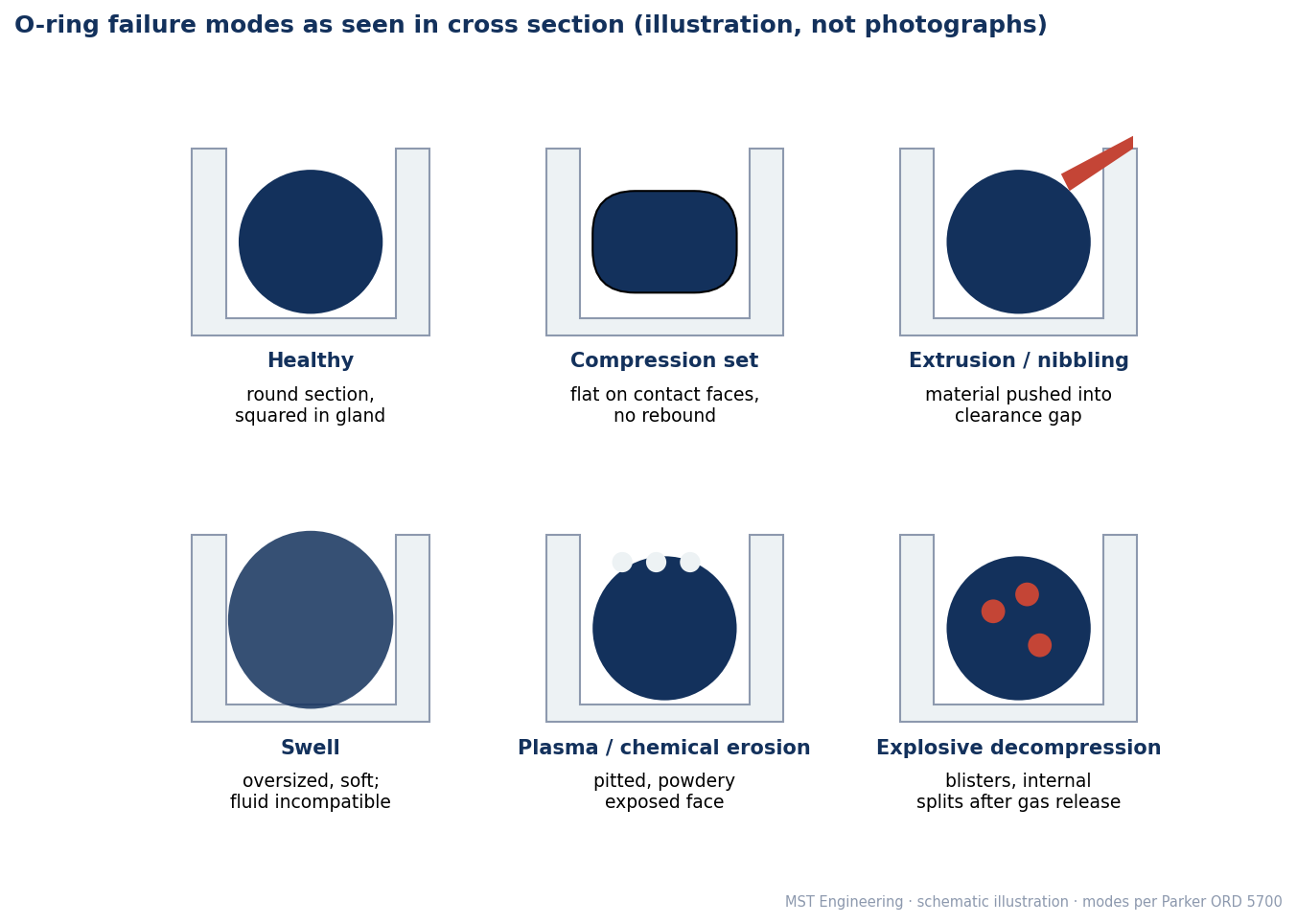
Illustration by MST Engineering. These are schematics, not photographs of failed parts.
Step 1: Identify the failure mode
| What you see | Likely mode | Typical causes | First fixes to evaluate |
|---|---|---|---|
| Flat faces matching the gland, no rebound | Compression set | Temperature above the compound's limit, excessive squeeze, long dwell | Higher-temperature grade; check gland squeeze |
| Ragged or nibbled edge on the low-pressure side | Extrusion / nibbling | Clearance gap too large, pressure too high, compound too soft | Harder compound, backup ring, tighter clearance |
| Ring larger and softer than new | Swell (chemical incompatibility) | Elastomer family not resistant to the fluid or gas | Change family, for example FKM to FFKM |
| Pitted, eroded or powdery exposed face | Plasma or chemical attack | Fluorine or oxygen radicals, aggressive cleans | Plasma-grade FFKM; check the exposed area |
| Surface blisters, internal splits | Explosive decompression | Gas absorbed under pressure, released quickly | Decompression-resistant compound, slower venting |
| Cuts or slices, often at one spot | Installation damage | Sharp edges, threads, twisting during fitting | Chamfer, lubricate or protect during installation |
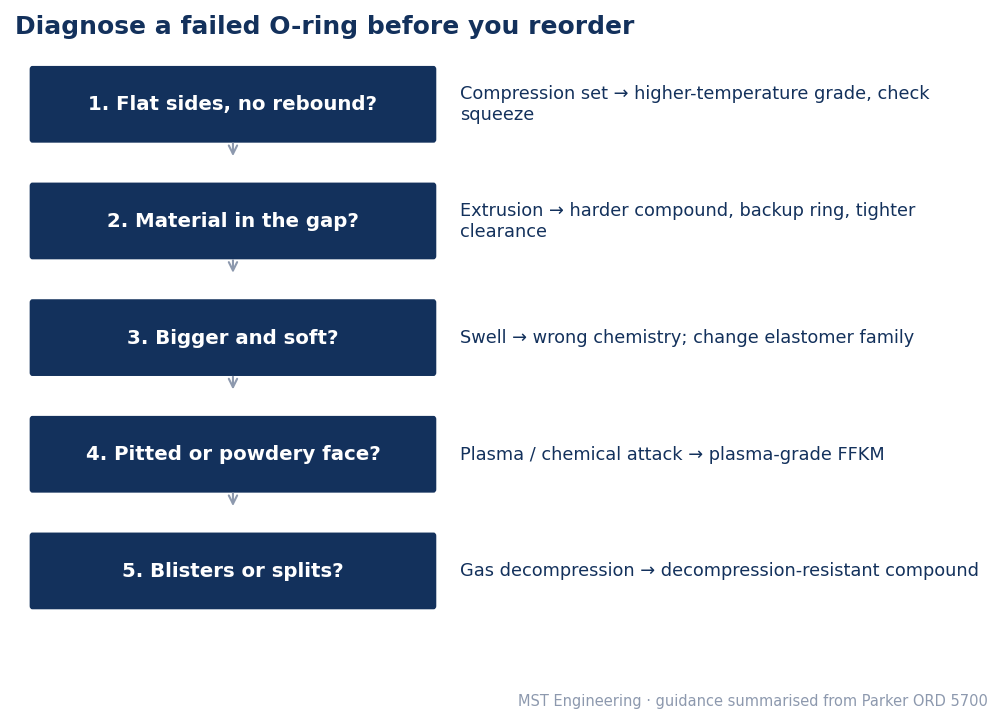
Flowchart by MST Engineering, summarised from Parker ORD 5700.
Step 2: Choose the elastomer family by chemistry
| Property | FFKM | FKM | EPDM |
|---|---|---|---|
| Upper service temperature | 275–327 °C depending on grade | Up to 204 °C | Up to 150 °C (204 °C in water or steam) |
| Plasma (F, O radicals) | Best; dedicated plasma grades | Erodes faster | Not a plasma-chamber material |
| Chemicals | Broadest resistance | Not amines, ammonia, alkalis, superheated steam | Hot water, steam, many acids and alkalis; not mineral oils |
| Typical tool location | Chamber lids, gas inlets, slit valves | Milder static seals, pumps, foreline | Wet benches, DI-water lines |
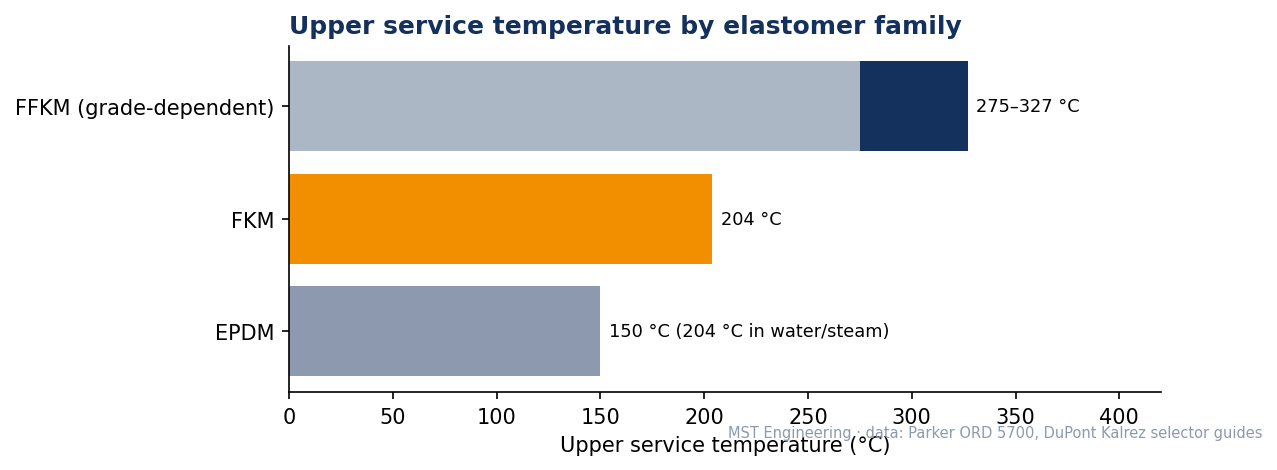
Chart by MST Engineering from Parker ORD 5700 and the DuPont Kalrez selector guides.
Step 3: Within FFKM, choose the grade by process
| Kalrez grade | Shore A | Max. service temperature | Suggested processes (DuPont) |
|---|---|---|---|
| 9100 | 70 | 300 °C | HDPCVD, conductor etch |
| 9300 | 77 | 300 °C | Conductor and dielectric etch, ash/strip |
| 9500 | 76 | 310 °C | HDPCVD, SACVD/FCVD, PECVD curing |
| 9600 | 70 | 315 °C | PECVD/PEALD, SACVD/FCVD |
| 8002 | 69 | 275 °C | Ash/strip |
| 8705 | 77 | 327 °C | PECVD curing (quartz window seal) |
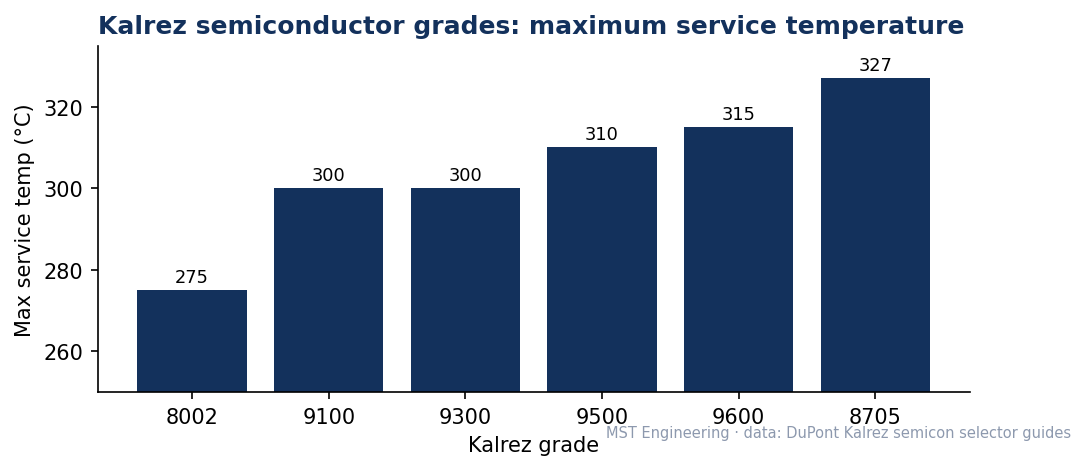
Chart by MST Engineering from the DuPont Kalrez semiconductor selector guides.
Other manufacturers make FFKM grades for the same processes, including Greene Tweed (Chemraz) and MORISEAL. Compare their published data for your process, and validate on the tool.
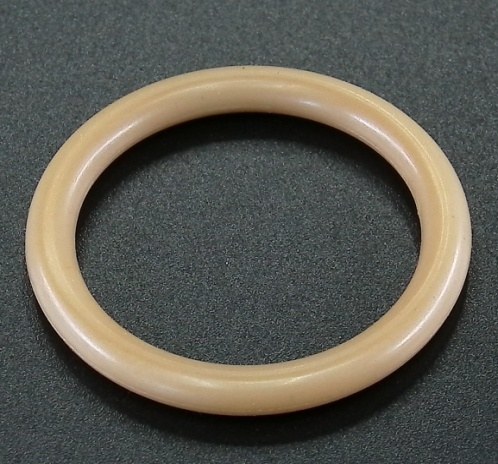
Representative product photo (MORISEAL 5130UP). Colour and finish vary by compound.
Step 4: Write the replacement spec
1. Record the dash number or ID × CS (see our [AS568 sizing summary](/community/c/o-rings-seals)), the gland type and its measured clearance.
2. Record the failure mode from Step 1 with a photo of the failed ring in cross section.
3. Record the process chemistry, the maximum seal temperature (not the chamber setpoint) and the pressure cycle.
4. Choose the family (Step 2) and the grade (Step 3), and plan a tool validation run before you change the whole fleet.
Original OEM documents (links only)
1. Parker Hannifin, Parker O-Ring Handbook ORD 5700 (failure analysis and compound selection). https://www.parker.com/content/dam/Parker-com/Literature/O-Ring-Division-Literature/ORD-5700.pdf
2. DuPont, Kalrez semiconductor product selector guide, plasma processes. https://www.pp.dupont.com/content/dam/electronics/amer/us/en/kalrez/public/documents/en/Semicon%20Product%20Selector%20Guide%20-%20Plasma%20-%20KZE-A40111-00-A0422.FinalRev.pdf
3. DuPont, Kalrez semiconductor product selector guide, thermal processes. https://www.pp.dupont.com/content/dam/electronics/amer/us/en/kalrez/public/documents/en/Semicon%20Product%20Selector%20Guide%20-%20Thermal%20-%20KZE-A40112-00-A0422.FinalRev.pdf
Ask an engineer
Send a photo of the failed ring, the dash number, the process and the seal temperature through [Ask an engineer](/rfq?entry_source=ask_engineer&search_term=O-ring+failure+analysis&quantity=1&community_path=%2Fcommunity%2Fc%2Fo-rings-seals). MST shortlists compounds to validate and quotes the sizes you need. Browse [AS568 O-rings](/store/as568-o-rings), or post a [find-part request](/community/new?kind=part_request&mpn=AS568-214). For parts outside this list, use a [sourcing RFQ](/services/sourcing-rfq?sourcing_mode=supplier_match).
Catalog parts in this guide