
**Short answer:** DuPont splits its semiconductor Kalrez recommendations across three 4-page selector guides: Plasma (KZE-A40111), Thermal (KZE-A40112) and Wet (KZE-A40110). In the plasma guide, 9100/9500 are listed for HDPCVD, 9600 for PECVD/PEALD, 9100/9300 for conductor etch, 9300 for dielectric etch and 9300/8002 for ash/strip. 8900/7075UP cover ALD/LPCVD/metal CVD and diffusion, and W240UP covers wet processing. The property tables are typical values that the documents themselves say are "not to be used for specification purposes". The same grade appears with different compression-set numbers in two of the guides, so an RFQ should name the compound **and** the process, not a single datasheet number.
Where to find the documents
All three are public PDFs on DuPont's Kalrez site (the URLs are under `pp.dupont.com/content/dam/electronics/.../kalrez/public/documents/en/`). If a link moves, search the **form number**, not the title: `KZE-A40111` (Plasma), `KZE-A40112` (Thermal), `KZE-A40110` (Wet). Form numbers outlive page titles. Each guide prints its form number and revision in the footer. Plasma and Thermal are "Rev. 0, June 2022", Wet is "Rev. 0, August 2022". Always note which revision you used.
How to read a Kalrez compound name
- The name is a **compound (material) designation**, not a size. "Kalrez 9600" says nothing about ID or cross-section. Size is a separate field: an AS568 dash number or a custom drawing. DuPont's own test footnotes refer to "AS568 K214 O-ring test specimens" for compression set, which tells you the published numbers come from a standard test ring, not from your gland.
- **"UP" suffix.** The thermal guide says "Ultrapure post-cleaning and packaging is standard for all parts made from Kalrez® 7075UP". The wet guide says "Ultrapure processing is standard for all semiconductor product grades". The plasma guide's intro says a proprietary ultraclean process and cleanroom handling is standard for all Kalrez semiconductor products. So a missing "UP" in a grade name (9100, 9600…) does **not** mean the part ships without ultraclean processing. Confirm the packaging and cleaning spec in writing instead of inferring it from the suffix.
Process → suggested grade (from the selector tables)
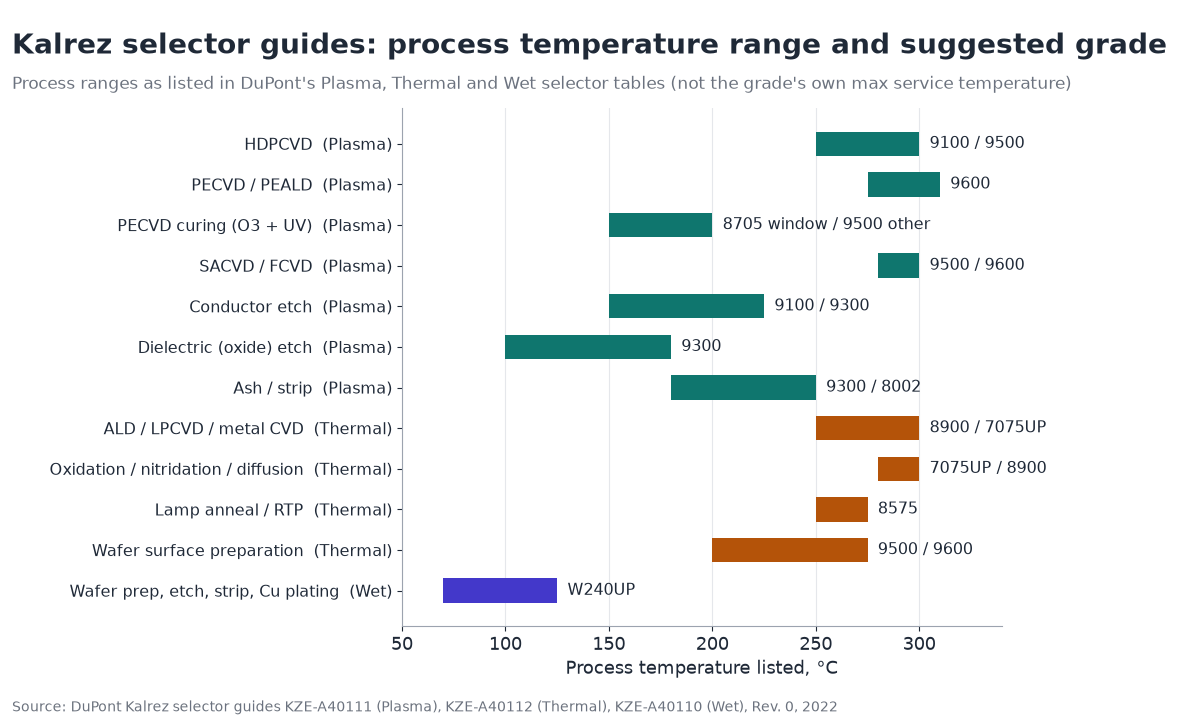
| Guide | Process type | Process temperature listed | Suggested Kalrez grade(s) |
|---|---|---|---|
| Plasma | HDPCVD | 250–300 °C | 9100 / 9500 |
| Plasma | PECVD / PEALD | 275–310 °C | 9600 |
| Plasma | PECVD curing (O3 + UV) | 150–200 °C | 8705 (quartz window seal), 9500 (all other seal locations) |
| Plasma | SACVD / FCVD | 280–300 °C | 9500 / 9600 |
| Plasma | Conductor (poly/metal) etch | 150–225 °C | 9100 / 9300 |
| Plasma | Dielectric (oxide) etch | 100–180 °C | 9300 |
| Plasma | Ash / strip | 180–250 °C | 9300 / 8002 |
| Thermal | ALD / LPCVD / metal CVD | 250–300 °C | 8900 / 7075UP |
| Thermal | Oxidation / nitridation / diffusion | 280–300 °C | 7075UP / 8900 |
| Thermal | Lamp anneal / RTP | 250–275 °C | 8575 |
| Thermal | Wafer surface preparation | 200–275 °C | 9500 / 9600 |
| Wet | Wafer prep, etching, stripping, Cu plating | 70–125 °C (by step) | W240UP |
**Ambiguity to watch:** the selector-table column is headed "Maximum Service Temperature", but its values are *process* ranges (e.g. 100–180 °C for oxide etch). The separate "Typical Physical Properties" table gives each grade's own maximum service temperature (e.g. 9300: 300 °C). Keep the two apart. A buyer who quotes "9300 is good to 180 °C" has read the wrong column.
Typical properties, and the inconsistency between guides
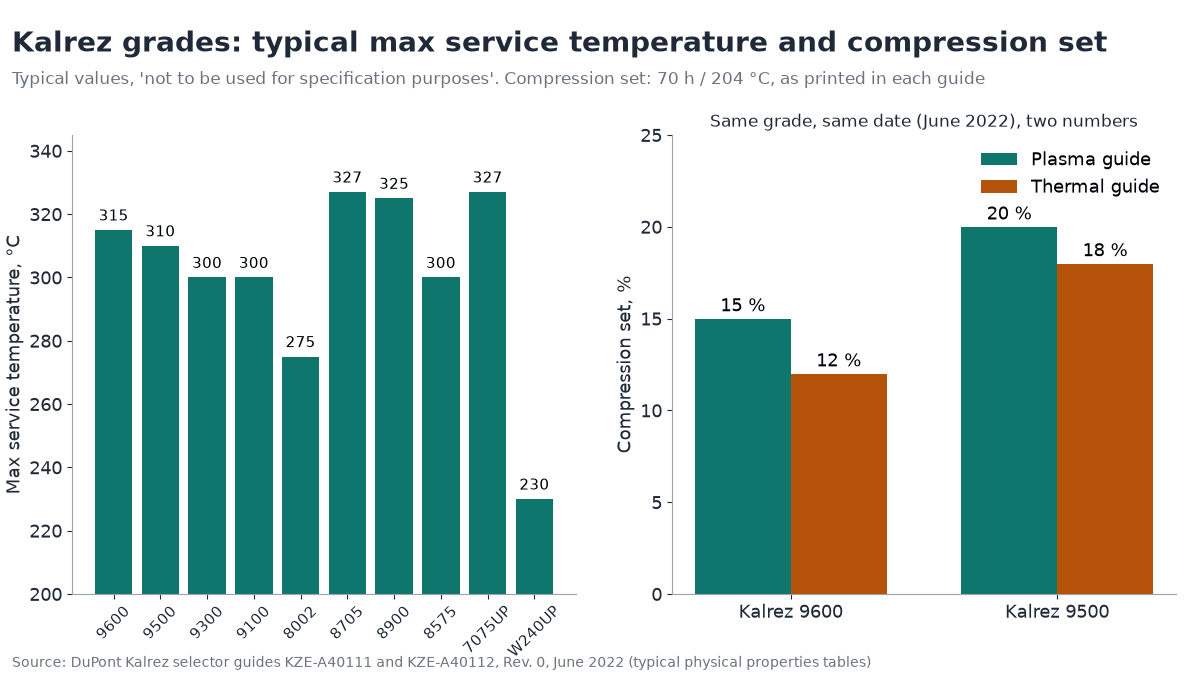
| Grade | Colour | Hardness, Shore A | Max service temp, °C | Compression set 70 h / 204 °C, % (Plasma guide) | Same, % (Thermal guide) |
|---|---|---|---|---|---|
| 9600 | Olive-green | 70 | 315 | 15 | **12** |
| 9500 | Tan | 76 | 310 | 20 | **18** |
| 9300 | Brown | 77 | 300 | 25 | n/a |
| 9100 | Amber | 70 | 300 | 18 | n/a |
| 8002 | Clear | 69 | 275 | 12 | n/a |
| 8705 | Black | 77 | 327 | 24 | n/a |
| 8900 | Black | 76 | 325 | n/a | 20 |
| 8575 | White | 63 | 300 | n/a | 25 |
| 7075UP | Black | 75 | 327 | n/a | 13 |
| W240UP | Black | 76 | 230 | n/a | n/a (Wet guide: 26) |
What the table tells a sourcing engineer:
1. **Two guides, same date, different numbers.** 9500 is listed at 20 % compression set in the Plasma guide and 18 % in the Thermal guide. 9600 is 15 % vs 12 %. Both guides are Rev. 0, June 2022. Neither is wrong as a "typical" value, but neither is a spec. When a supplier quotes a compression-set figure, ask which document and revision it came from.
2. **Hardness test basis differs.** Footnotes distinguish pellet test specimens from "plied slab test specimens" (several grades, e.g. 9600, 9500, 9300, 9100, 8002, 8705, 8900, carry the plied-slab footnote). Don't compare hardness across makers unless the specimen type matches.
3. **Max service temperature is a DuPont proprietary method**, and the footnote says "useful temperature range may vary with seal design and application specifics".
4. **Colour is a weak identifier.** Four grades in these guides are black (8705, 8900, 7075UP, W240UP). Colour can rule a grade out (an amber ring is not 9600) but cannot confirm one.
Static vs dynamic: read the grade notes
The text notes add constraints that the tables don't show. 9100 is "well suited for both static and 'select' dynamic sealing applications". 8002 is described as an unfilled, clear product "well suited for static, low stress/low sealing force and 'select' bonded door seal applications". 8705 targets seal locations in the direct path of UV, such as quartz windows in UV cure chambers. If the seal is a slit-valve door or gate seal (dynamic), say so in the RFQ: it can change which of the "suggested" grades is appropriate.
Equivalents and cross-references: evidence levels
Other FFKM makers publish their own grade families. For example, Greene Tweed's Chemraz G-Series datasheet (DS-US-CRZ-G-001, 04/25) describes G13 (to 220 °C), G20 (continuous use up to 300 °C) and G38 (up to 225 °C). These are each maker's application statements, measured by each maker's own methods.
| Claim | Evidence level |
|---|---|
| Kalrez grade X is DuPont's suggestion for process Y | **Documented by maker** (selector table) |
| Kalrez grade X and Chemraz grade Z are interchangeable | **Interchangeability not established.** No public head-to-head data was reviewed for this post |
| A ring with the same AS568 dash number in another FFKM fits the gland | **Dimensional match only.** It says nothing about plasma erosion, outgassing or particles |
Qualifying an alternative compound is the fab's or tool owner's decision. It usually needs process-chamber testing.
How to verify what you actually have
- Check the **bag label / CoC**: compound designation, size, lot. Don't rely on colour alone.
- Measure ID and cross-section after relaxation, and compare with the AS568 dash number or the drawing.
- Confirm the seal location (lid, door, gas inlet, window, centre ring) and whether it is static or dynamic.
- If the tool BOM lists an OEM seal part number rather than a compound, record both. The OEM number may bundle a specific compound and size.
What to send in an FFKM RFQ
1. OEM tool + chamber + seal location (e.g. "lid seal, PECVD chamber").
2. OEM part number if known, **and** compound if known (e.g. "Kalrez 9600"), or "open to qualified alternative".
3. Size: AS568 dash number, or ID × CS with tolerances / drawing.
4. Process chemistry and the highest seal temperature (not just the process temperature).
5. Static or dynamic.
6. Quantity, packaging (ultraclean, double-bagged), certificates required (CoC, lot traceability).
7. Whether only the named brand is acceptable (copy-exact) or an equivalent may be quoted.
FAQ
**Is Kalrez 9600 a direct upgrade for 9500?** The selectors list both for SACVD/FCVD and wafer surface preparation. For PECVD/PEALD only 9600 is listed. The guides do not call one a universal upgrade over the other, so treat it as a process-specific choice.
**Does a grade without "UP" come without ultraclean processing?** Not per these guides. They say ultraclean or ultrapure processing is standard for semiconductor grades. Confirm packaging in writing.
**Can I use the compression-set numbers as acceptance criteria?** No. Each guide marks the properties as typical and "not to be used for specification purposes".
**Which guide covers Kalrez for wet benches?** The Wet Processes guide (KZE-A40110). It lists W240UP and gives 672-hour immersion volume-change data (e.g. 2.3 % in 49 % HF at 23 °C).
*Kalrez® is a trademark of DuPont de Nemours, Inc. or its affiliates. Chemraz® is a trademark of Greene Tweed. Names and grade designations are used for identification only. MST is not affiliated with or endorsed by these companies.*
Original OEM documents (links only)
1. DuPont, "DuPont™ Kalrez® Perfluoroelastomer Parts in Semiconductor Industry – Plasma Processes", Product Selector Guide, Form No. KZE-A40111-00-A0422, Rev. 0, June 2022. https://www.pp.dupont.com/content/dam/electronics/amer/us/en/kalrez/public/documents/en/Semicon%20Product%20Selector%20Guide%20-%20Plasma%20-%20KZE-A40111-00-A0422.FinalRev.pdf
2. DuPont, "DuPont™ Kalrez® Perfluoroelastomer Parts in Semiconductor Industry – Thermal Processes", Form No. KZE-A40112-00-A0422, Rev. 0, June 2022. https://www.pp.dupont.com/content/dam/electronics/amer/us/en/kalrez/public/documents/en/Semicon%20Product%20Selector%20Guide%20-%20Thermal%20-%20KZE-A40112-00-A0422.FinalRev.pdf
3. DuPont, "DuPont™ Kalrez® Semicon Product Selector Guide – Wet Processes", Form No. KZE-A40110-00-A0822, Rev. 0, August 2022. https://www.pp.dupont.com/content/dam/electronics/amer/us/en/kalrez/public/documents/en/Semicon-Product-Selector-Guide-Wet-Processes-KZE-A40110-00-A0822.pdf
4. Greene Tweed, "Chemraz® G-Series" datasheet, 04/25-GT DS-US-CRZ-G-001. https://www.gtweed.com/wp-content/uploads/chemraz-G-series-sc-ds.pdf
Related MST thread: [Semiconductor O-ring RFQ checklist](/community/t/5-semiconductor-o-ring-rfq-checklist-dimensions-operating-cond)
Request a quote
Need a specific Kalrez grade and size located or quoted? Post a [find-part request](/community/new?kind=part_request&mpn=Kalrez%209600) with the details above, or send a [sourcing RFQ](/services/sourcing-rfq?sourcing_mode=supplier_match). MST replies in the thread or by email. MST does not claim stock of any item mentioned here; sourcing is done on request.
料号