
Start an MPW project with a non-confidential brief: circuit purpose, essential process options, estimated die size, sample needs and dates. This can begin a feasibility discussion before final GDS exists. First establish whether a suitable manufacturing route can be identified; access, a quotation and a shuttle reservation are separate decisions.
About this guide: MST is a commercial intermediary for sourcing and project coordination. We must first check process fit with the relevant provider before discussing an available route. The examples below do not establish MST access to any particular process, foundry or shuttle. Official sources checked on 2026-11-06.
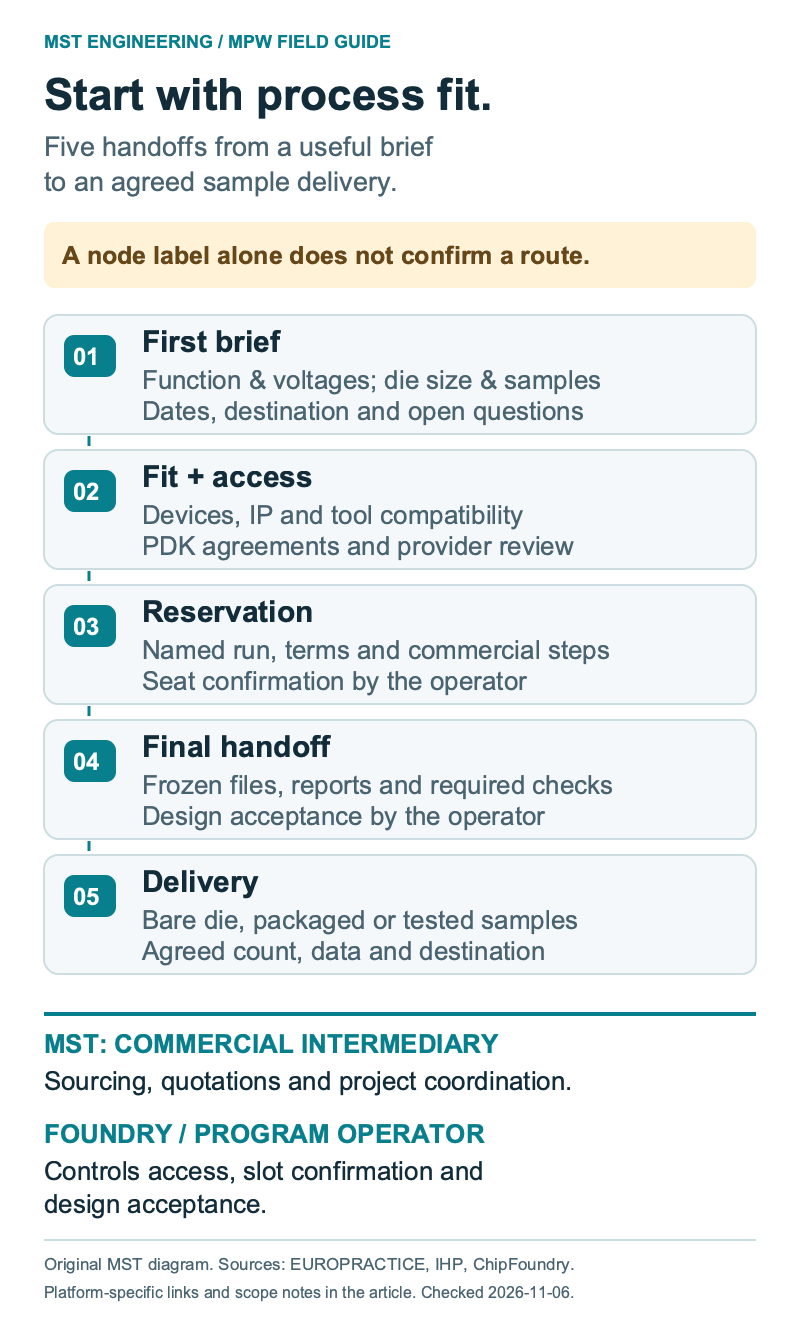
Original MST diagram. Full-size view (https://store.mst-sg.com/storefront/community-guides/mpw-five-handoffs-process-fit-20261106.png) . The stages are a planning framework, not a universal foundry procedure.
How to find a foundry or a commercial intermediary
Begin with the devices and interfaces your circuit needs. A node label alone cannot tell you whether the required voltage devices, memory, RF options, metal stack or licensed IP are available in a usable flow. Describe those requirements before choosing a provider on price or a calendar date.
Use this MST route-selection worksheet when comparing contacts:
| Route | What to ask at the first contact |
|---|---|
| Foundry | Does it accept this type of prototype inquiry directly, and who reviews process suitability and customer access? |
| MPW program or aggregator | Which exact platform and run could be evaluated, what access conditions apply, and what does the service include? |
| Commercial intermediary | Which parties would perform fabrication, assembly and test? What coordination is included, and what remains subject to their confirmation? |
EUROPRACTICE provides one concrete access example: customers choose a technology and contact the responsible partner. Its access page also describes fabrication access for non-member companies worldwide at standard prices. That is a program-specific route, not evidence of a relationship with MST. Source: EUROPRACTICE foundry access (https://europractice-ic.com/access-and-registration/foundry-access-and-membership/) .
Foundry not replying? Make the first request easier to review
A quiet inbox does not establish that your process is unsuitable. As a practical next step, make the request specific enough to route to the right team. State the application, essential devices and voltages, approximate dimensions, sample form and design-readiness date. Ask whether the recipient can review the project or direct you to the relevant MPW contact.
If you approach a commercial intermediary, ask for a clear division of responsibilities and the evidence needed to confirm a route. Keep unanswered items visible. Avoid treating a positive introductory conversation as process approval, PDK access or a reserved seat.
Prepare a non-confidential project brief
The worksheet below is MST's suggested intake, not a mandatory form shared by all foundries. Use confirmed, estimate or unknown beside each answer. For an overseas project, include your organization and receiving country so the proposed access and delivery route can be assessed.
| Brief field | Useful first-round information |
|---|---|
| Purpose and success criteria | What must the first silicon demonstrate, and which measurements will establish success? |
| Process needs | Candidate platform if known; essential device types, voltage domains, memory/IP and metal options |
| Design and tools | Current stage, EDA tools, required libraries and whether the intended PDK is already available to your team |
| Die estimate | Width and height, approximate pad count and which dimensions may still change |
| Samples | Requested quantity and whether you need bare dies, assembled samples or a defined test service |
| Timing | Expected design-ready date and desired samples-in-hand date; identify any fixed deadline |
| Access and destination | Organization/country, receiving country, agreement status and authorized technical contact |
| Open questions | Missing information, decision owner and the next evidence needed |
For example, a useful brief describes an analog prototype's required supply domains, estimated die outline, sample target and planned measurements. It does not need to reveal the circuit in a public discussion. Arrange the recipient, applicable agreements and secure transfer method before sharing restricted PDK material, GDS, netlists or proprietary IP.
The PDK requirement checklist (https://mst-sg.com/tools/pdk-checklist/) and MPW RFQ pack builder (https://mst-sg.com/tools/mpw-rfq-pack/) can organize this information. They do not perform foundry signoff.
Confirm process fit, PDK access and the design flow
Resolve three questions with the selected provider: Does the technology fit? Can this team access it? Can the intended design flow produce the required handoff? Record the exact process options, PDK release, libraries and supported verification setup rather than writing only a nominal node.
EUROPRACTICE links foundry-specific NDA and Design Kit License Agreement requirements on its access page above. An open design route has its own terms too: IHP's lowest-cost open-source program requires Apache 2.0 publication, compatibility with open-source EDA tools and a participation agreement. IHP also describes a separate private-IP route. These conditions apply to that program, not every MPW. Source: IHP Open-Silicon MPW Access (https://dk.ihp-microelectronics.com/OpenSourceRequest.php) .
Ask who provides design support, who performs each verification step and who can accept exceptions. An intermediary's introduction does not grant PDK rights or replace the operator's technical acceptance.
A shuttle reservation and a final tapeout are different handoffs
Track each milestone separately. This published EUROPRACTICE example is subject to availability and provider confirmation; it is not an MST offer.
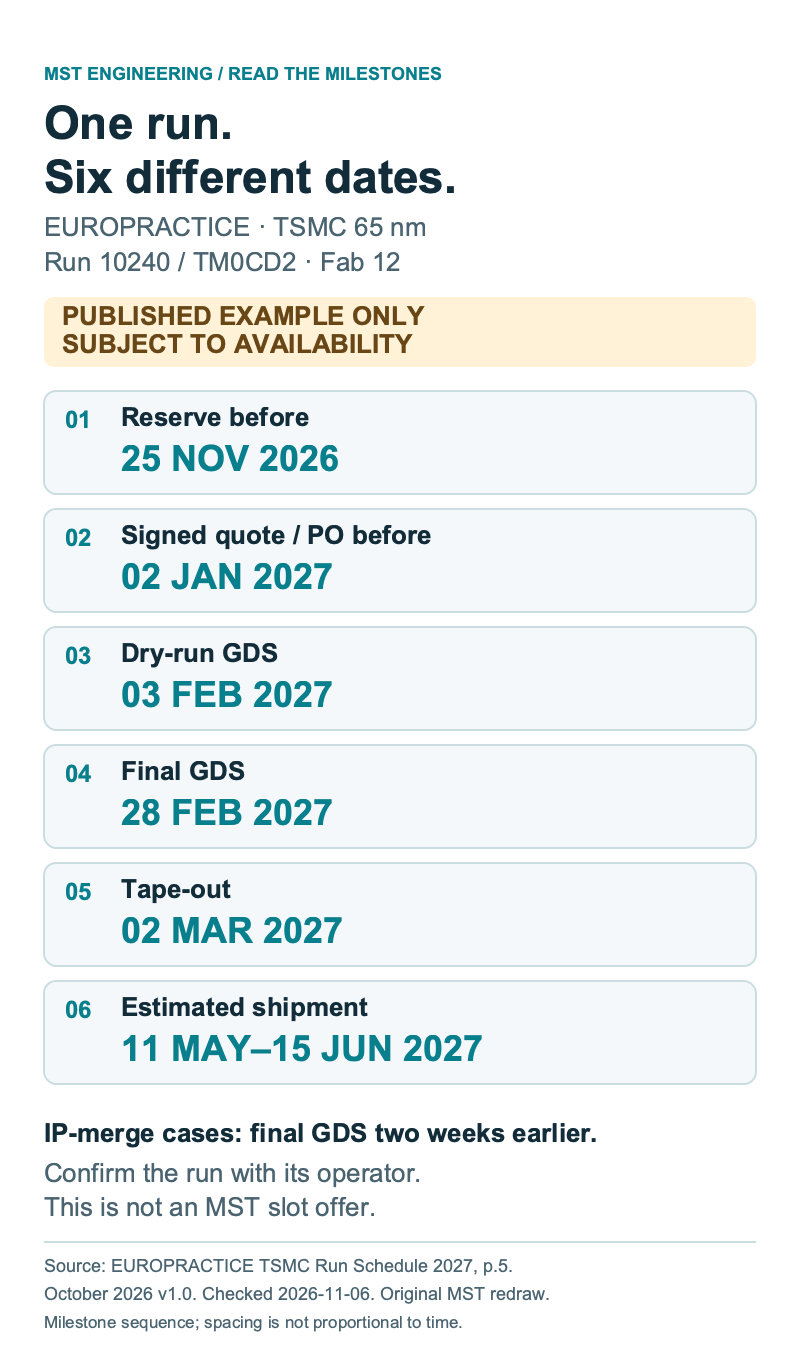
Original MST redraw. Full-size view (https://store.mst-sg.com/storefront/community-guides/mpw-reservation-vs-tapeout-example-20261106.png) . Source: EUROPRACTICE TSMC 2027 schedule, v1.0, page 5 (https://europractice-ic.com/wp-content/uploads/2026/11/TSMC_EP_MPW_schedule_2027_V1_0-1.pdf) . Confirm the selected run; shipment is estimated.
Final data depends on the chosen route. IHP's open-silicon workflow calls for release GDS, a matching netlist, metadata and documentation, plus seal ring, fillers and clean DRC/LVS. Its documentation also explains that incomplete artifact references can cause verification stages to be skipped. Check what actually ran, not only whether a workflow ended successfully. Source: IHP IP development steps (https://github.com/IHP-GmbH/Open-Silicon-MPW/blob/main/IP-development-steps.md) .
ChipFoundry's wrapper-based flow instead specifies the appropriate wrapper GDS and, for digital/analog projects, a GPIO definition file. Setup and precheck precede submission; uploading, review and final confirmation are separate operations. Follow that platform's current instructions rather than applying its file list to an unrelated foundry. Source: ChipFoundry CLI guide (https://github.com/chipfoundry/cf-cli) .
Define what arrives: bare die, packages or tested samples
Write the deliverable in the quotation. IHP's general MPW page, for example, states 40 diced samples by default, with 25 for its listed TSV and SG25_H7PIC exceptions, and includes E-test data and RF measurements. This does not establish a customer-specific functional-test service or packaged delivery. Source: IHP schedule and delivery terms (https://www.ihp-microelectronics.com/services/research-and-prototyping-service/mpw-prototyping-service/schedule-price-list) .
As an MST scope checklist, confirm die count and thickness, handling, package fit, bonding information, assembly responsibility, test coverage and data, and shipping destination. Ask which items are included, excluded or still unconfirmed. Preparing the test board and fixture can be part of your own project work even when fabrication is outsourced.
Primary references and further reading
The six official sources linked above describe separate programs. Use the selected operator's current documents for project decisions. Continue with these detailed MST worksheets:
- Quotation comparison (https://store.mst-sg.com/community/t/32-comparing-mpw-quotations-normalize-fabrication-packaging-and) : align the scope before comparing prices.
- Tapeout handoff (https://store.mst-sg.com/community/t/33-mpw-tapeout-handoff-match-gds-verification-reports-and-the) : connect a frozen release to its reports and owners.
- Bare die to first silicon (https://store.mst-sg.com/community/t/34-from-mpw-bare-die-to-qfn-samples-package-fit-sample) : prepare assembly, sample allocation and measurements.
Next step: request a process-fit review
Prepare the brief and your unresolved questions. You can ask MST to review whether a suitable sourcing route can be identified through the MPW inquiry form (https://store.mst-sg.com/mpw#mpw-inquiry-form) . Any proposed process, service or run must first pass the relevant suitability, access and availability checks. Use non-confidential information at this stage.
For general preparation questions, visit the MPW community (https://store.mst-sg.com/community/c/mpw) . MST's role is sourcing and project coordination; the selected foundry or program operator controls access, slot confirmation and design acceptance.